17 June 2026
On our second morning in Glacier, as on the first, we all were awoken quite early by the local woodpecker. It was so loud in Ben’s cabin that he thought shots were being fired. Getting out of bed to investigate, Ben saw the bird pecking on the metal roof of his cabin. “Must be a really stupid woodpecker” he thought, “drilling where there would be no bugs”. Mentioning it to one of the early-morning staff, Ben learned that that particular woodpecker had claimed Cabin Circle D as his territory. He wasn’t looking for food, but a for mate. The sound of metal made him very attractive (or so the bird believed).
Our cabins are just steps away from Nell’s, so we filled up on breakfast sandwiches, French toast and our own homemade granola (you know by now that Mike and I never travel without our granola). It was a cold morning so we bundled up to take a ranger-lead hike to Red Rock Falls.
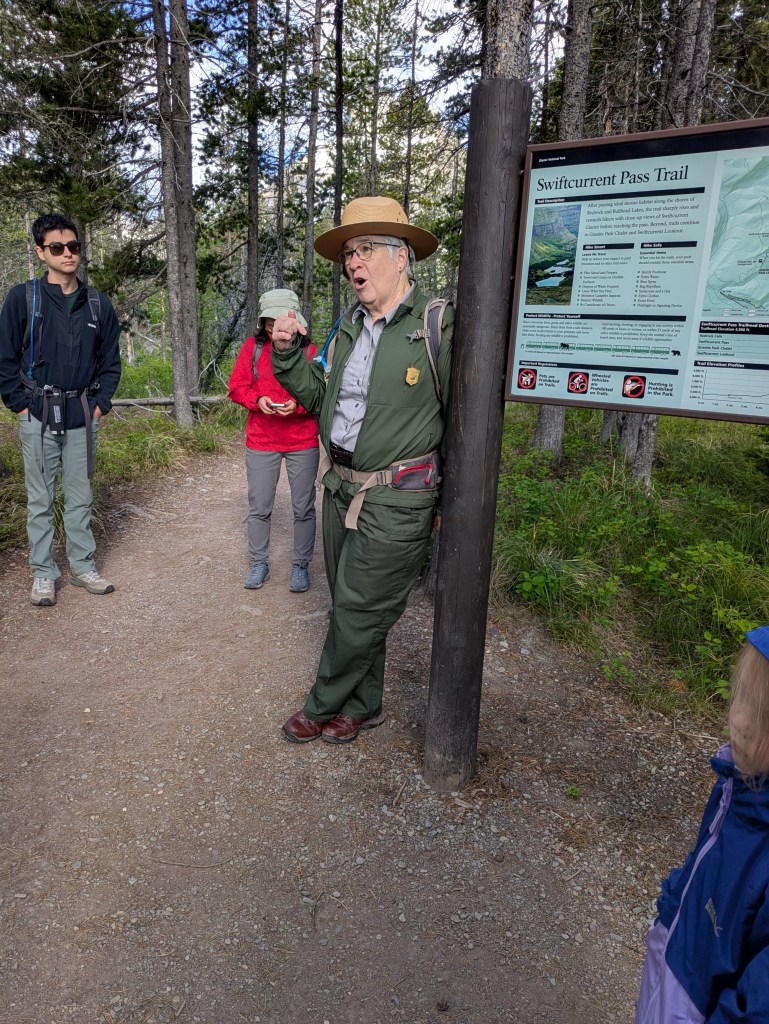
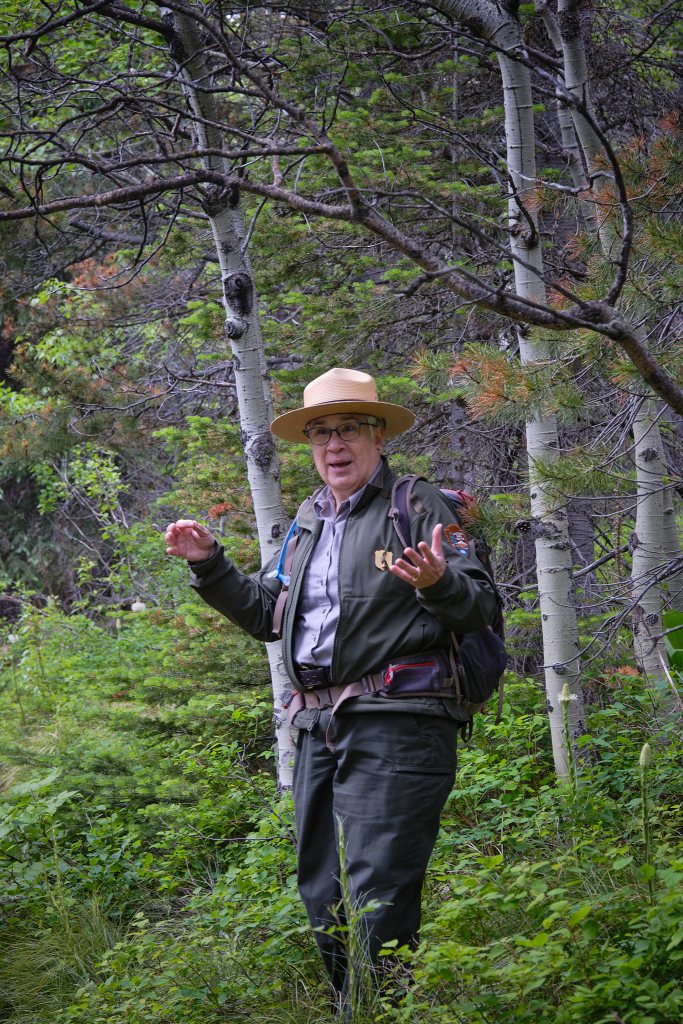
Our guide was Ranger Diane, who had given a talk we attended two nights ago on the human influences in The Many Glaciers area. This morning she lead everyone who showed up at 9am onto The Red Rock Falls Trail.
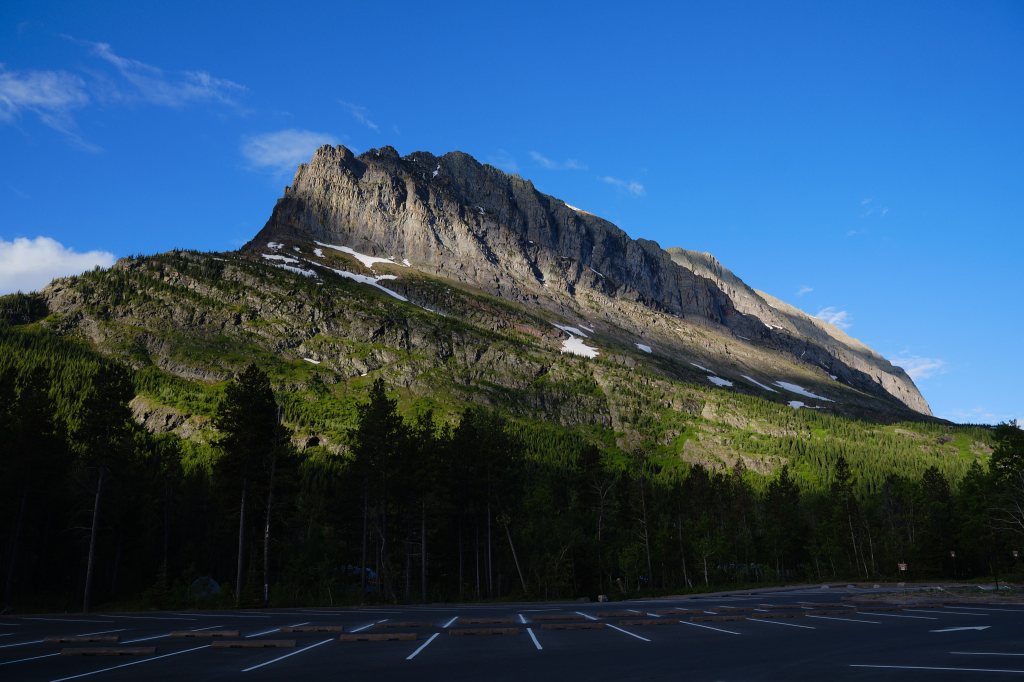
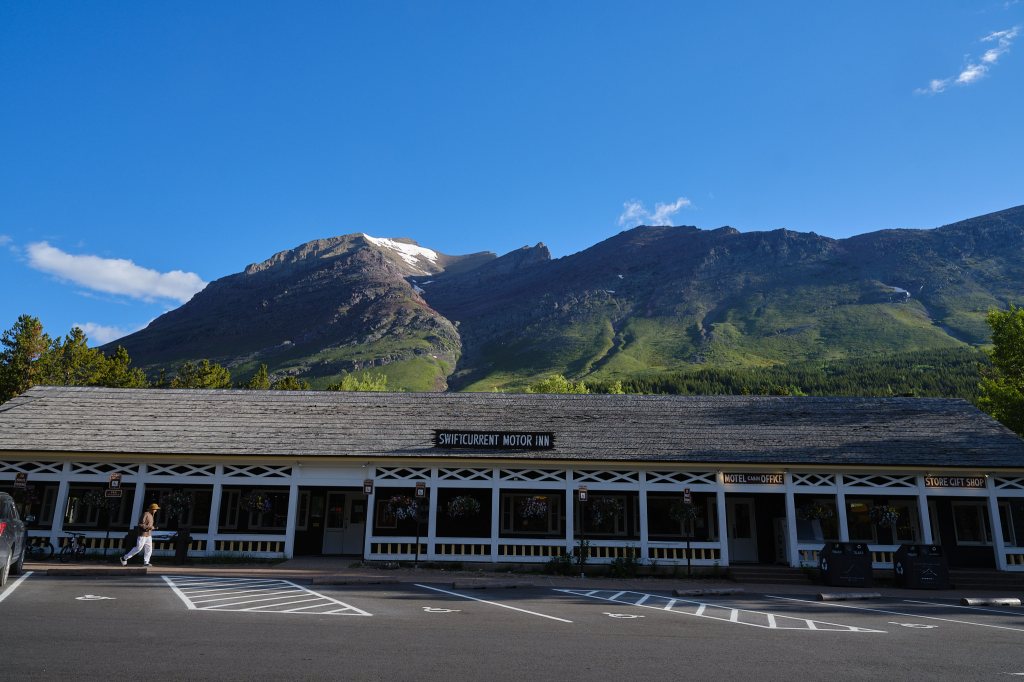
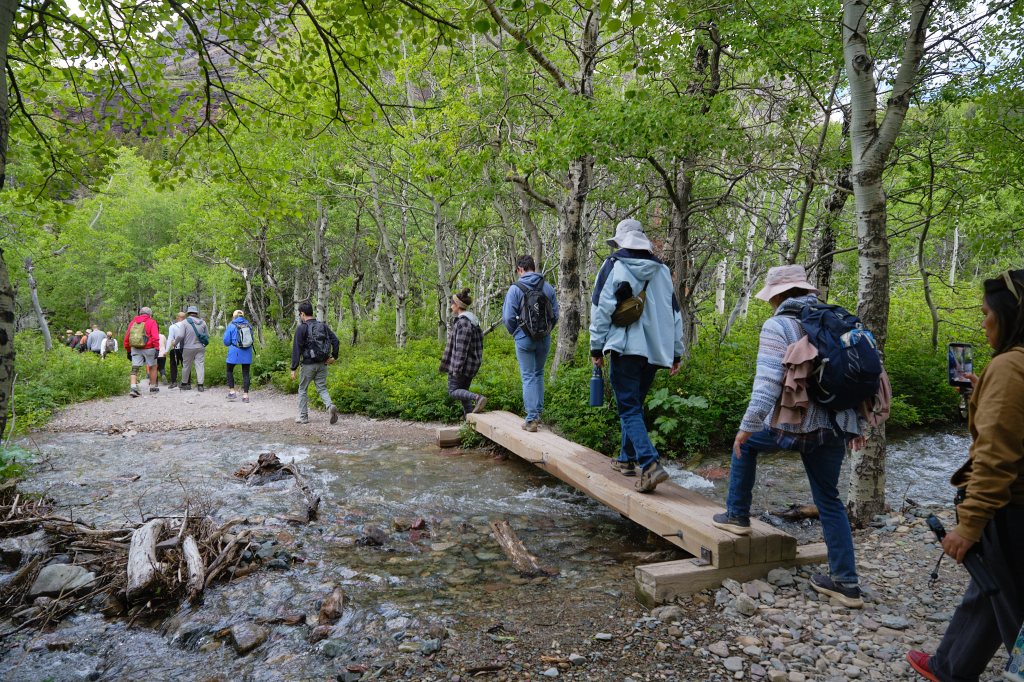
This is the most popular trail in East Glacier, and for good reason. It starts at the edge of the Swiftcurrent parking lot and travels 1.5 miles to a wide and rushing waterfall. The trail continues up, over and between peaks to the edge of a glacier but most people don’t do that. This short portion is a great introduction to the park for people of all ages.
I met my first friend at Glacier as the hike began: a little girl named Quinn. She and her parents had just arrived from Florida. They were such a sweet family! At our first stop along the trail Quinn was tasked by Ranger Diane to count the group (there were 25 of us) and she was the first to pose on a lodge pole pine sitting tree.
Scientists have not yet figured out what makes so many lodge pole pines in Glacier curve into “u” shapes. Could be snow, wind, a virus or even bears.
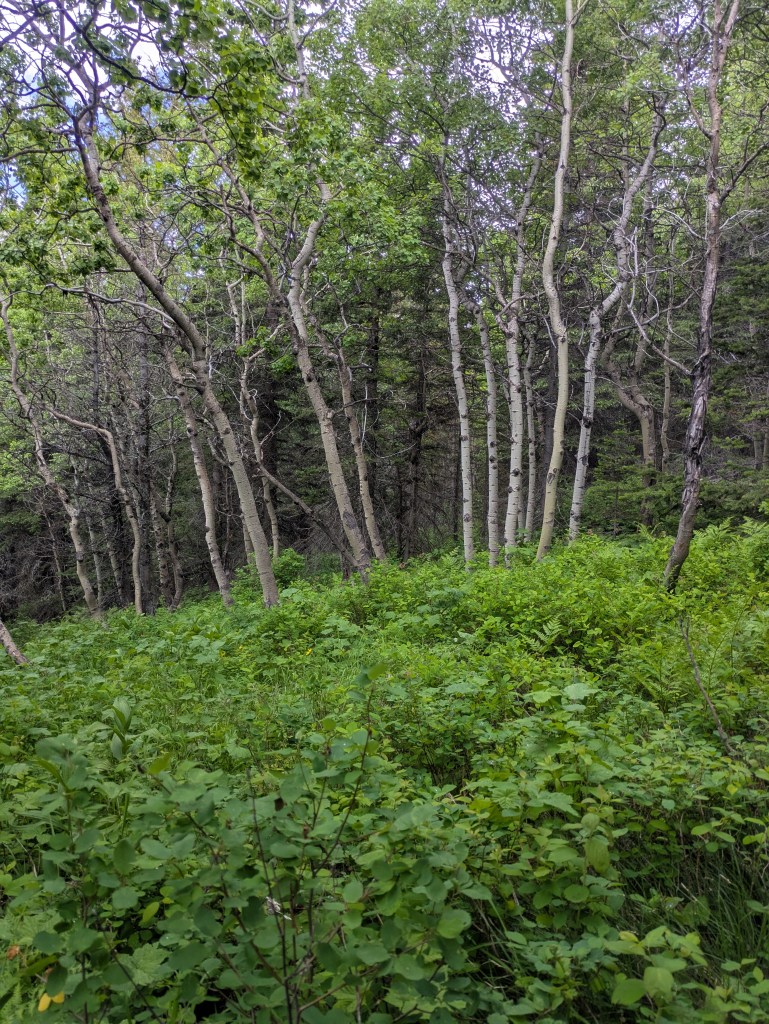
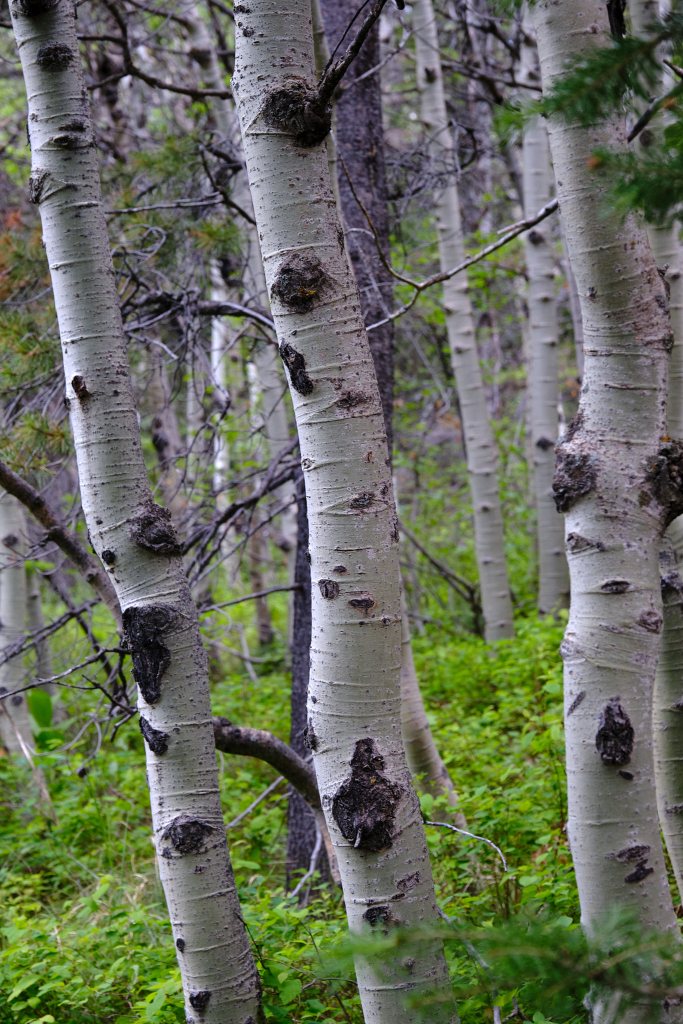
Another common variety of tree here is the aspen. They look a lot like birch trees but the bark is a pale green and does not peel as much. What is fascinating is that the roots of the trees send up shoots that grow into more trees, making an entire field of aspen trees count as just one organism. (You may have heard of Pando, a range of Aspen trees in Utah which covers over 105 acres and has been living there for over 14,000 years. It is considered the largest living single organism on the planet).
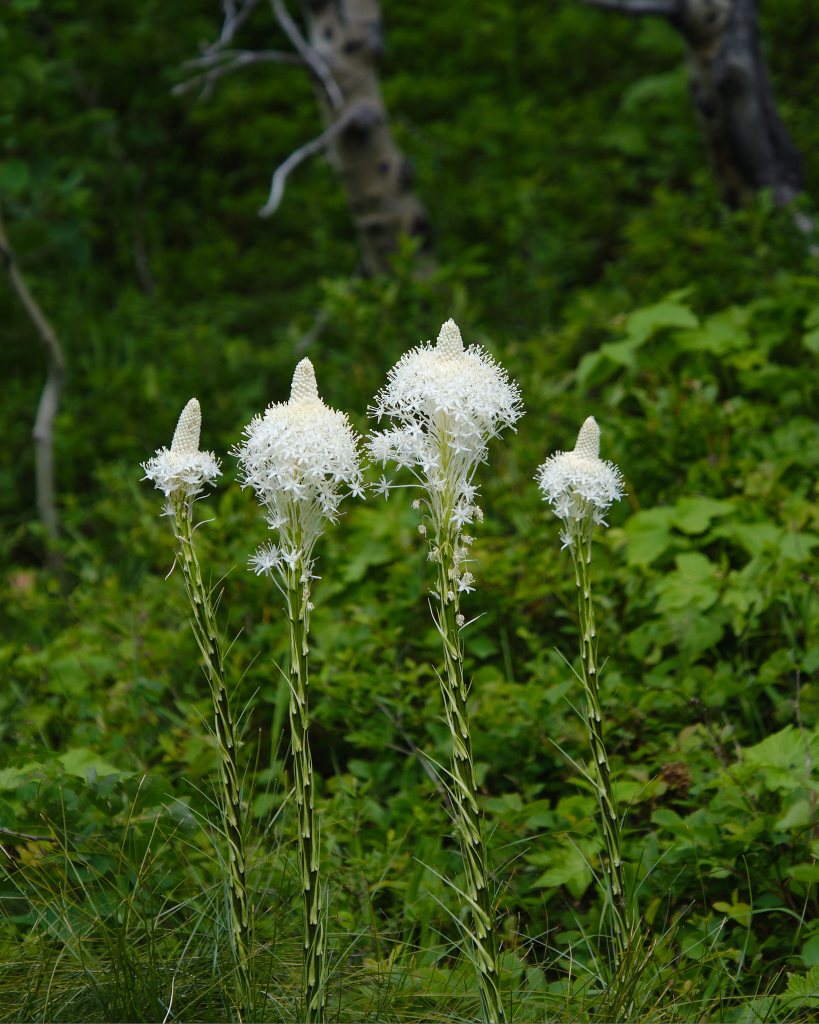
Puffy white cone-shaped flowers with thin leaves called bear grass lined the trail. Ranger Diane told us it was a great year for them and that this was peak season. She’s not sure what bears have to do with them, but the deer sure do like to eat them.
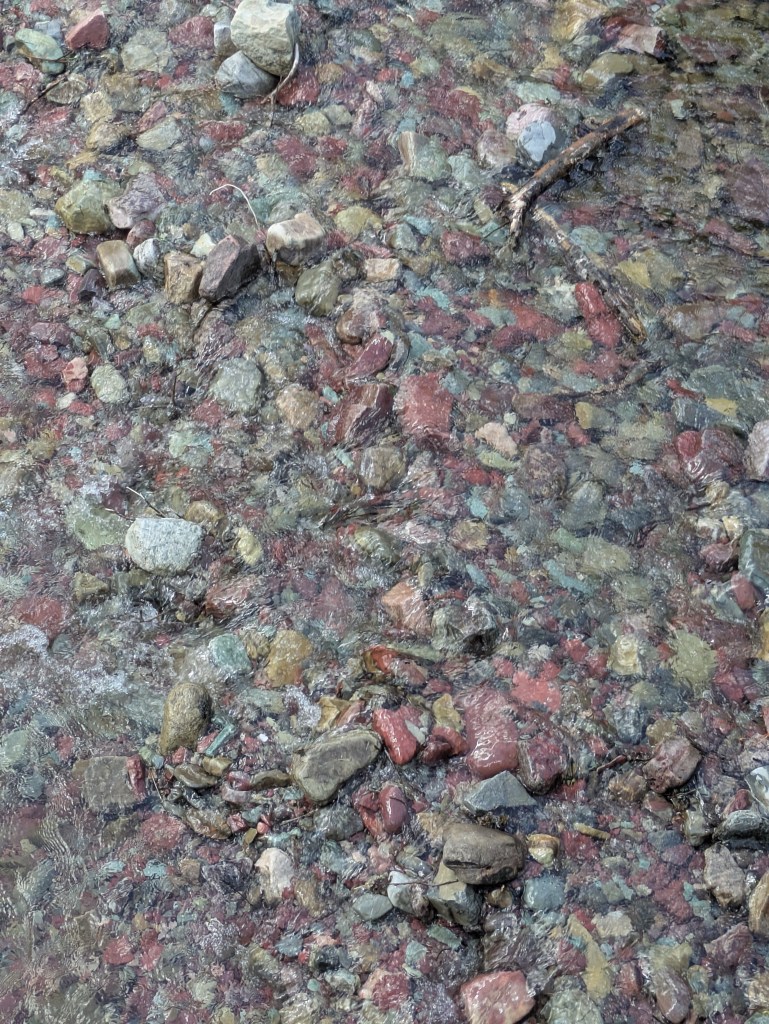
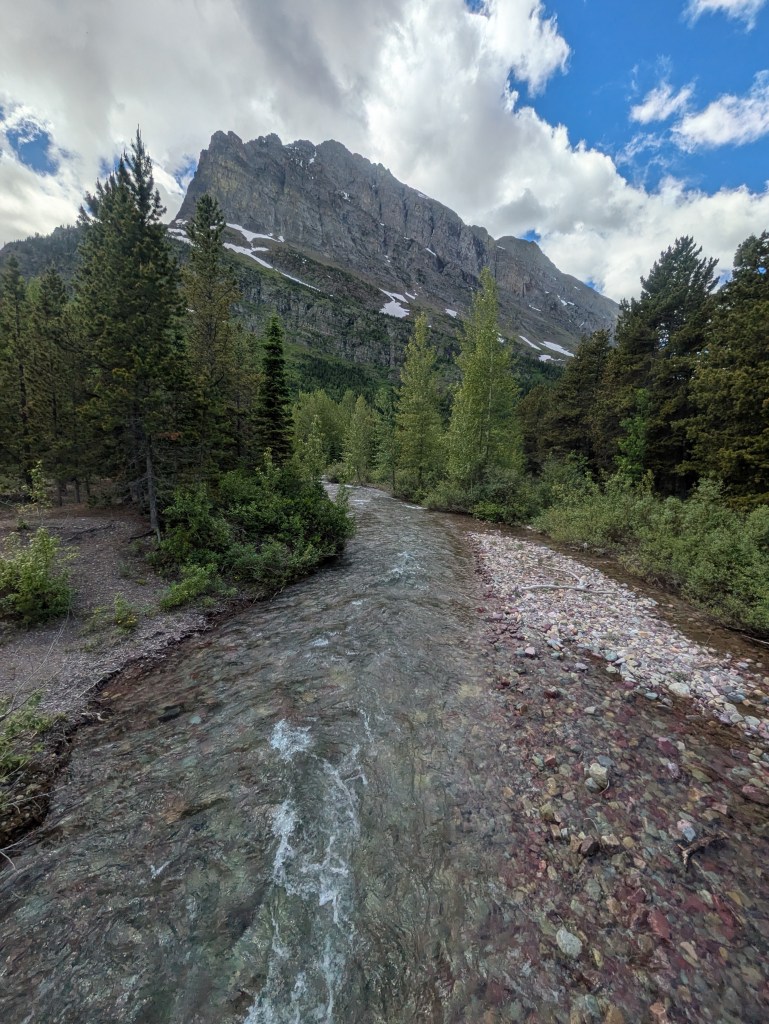
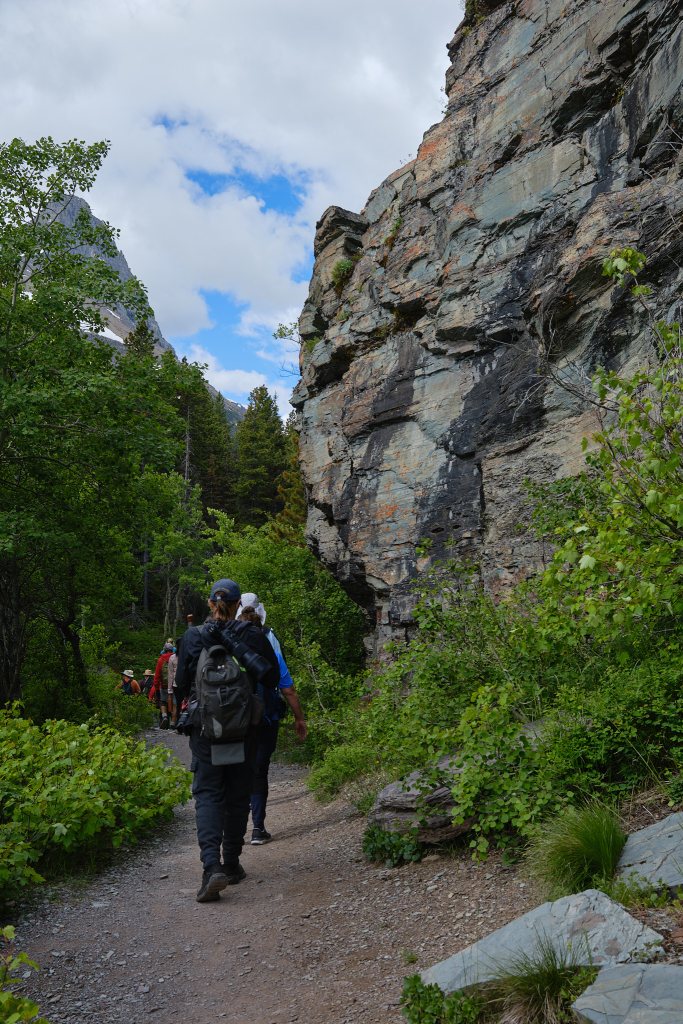
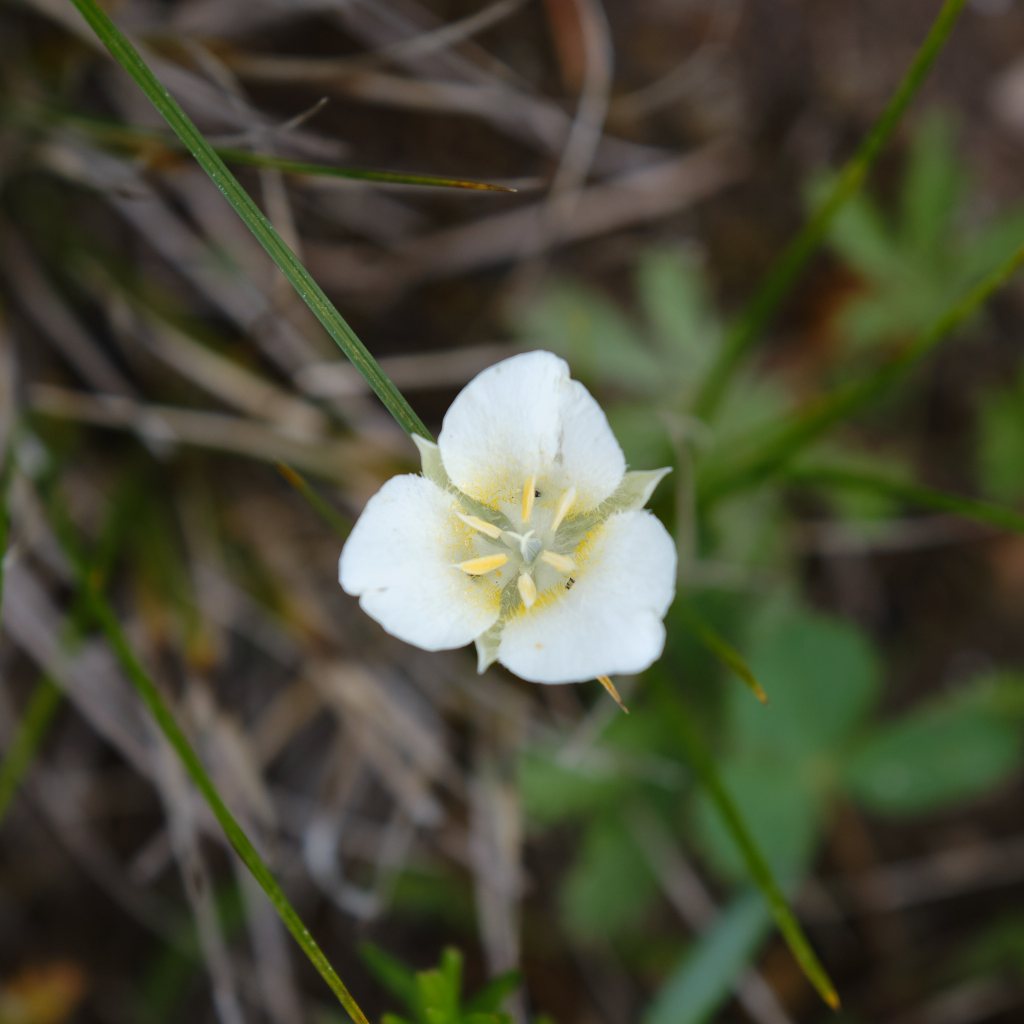
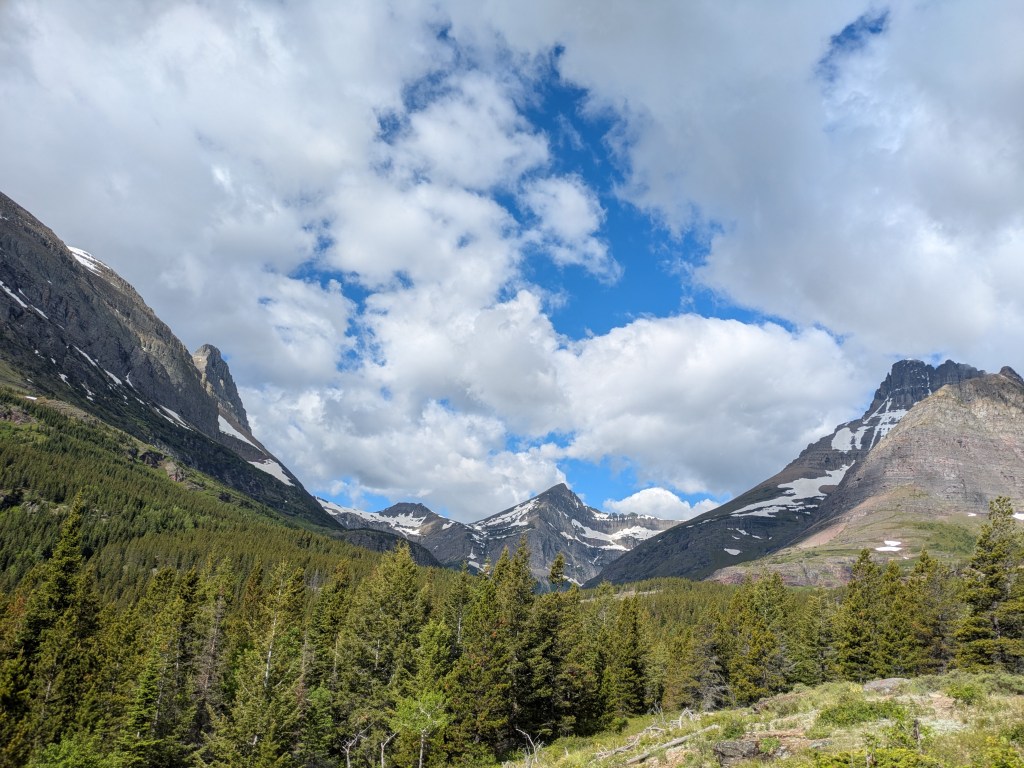
This trail is beautiful. Not only does it go across rushing brooks and through a dense forest strewn with wild flowers, but the rocks are a vivid red, green and yellow. There is so much of this colorful rock that it is used to make steps and walls throughout the park.
Diane explained that these mountains are made of sedimentary rocks with different levels of iron in them. It only took a slight difference in the mineral composition to make a dramatic difference in color. The area here had been underwater until tectonic plates smashed into each other, folded the rock over o itself and pushed the ocean away. Every now and then (geologically speaking) some magma shot up, changing a layer of sedimentary rock into granite. Then came the ice age. Glaciers formed and did their thing, carving the rock into peaks. A few thousand years of freezing and thawing until along came a smaller ice age in the mid 19th century. In our age of climate change the glaciers are rapidly thawing. Out of ninety glaciers existing when the park was established in 1910, only 26 remain.
All of this geological history makes for the spectacular scenery on display today (but not good rock climbing, apparently. Unlike the granite that makes up Yosemite, the rock here is too unstable and crumbly).
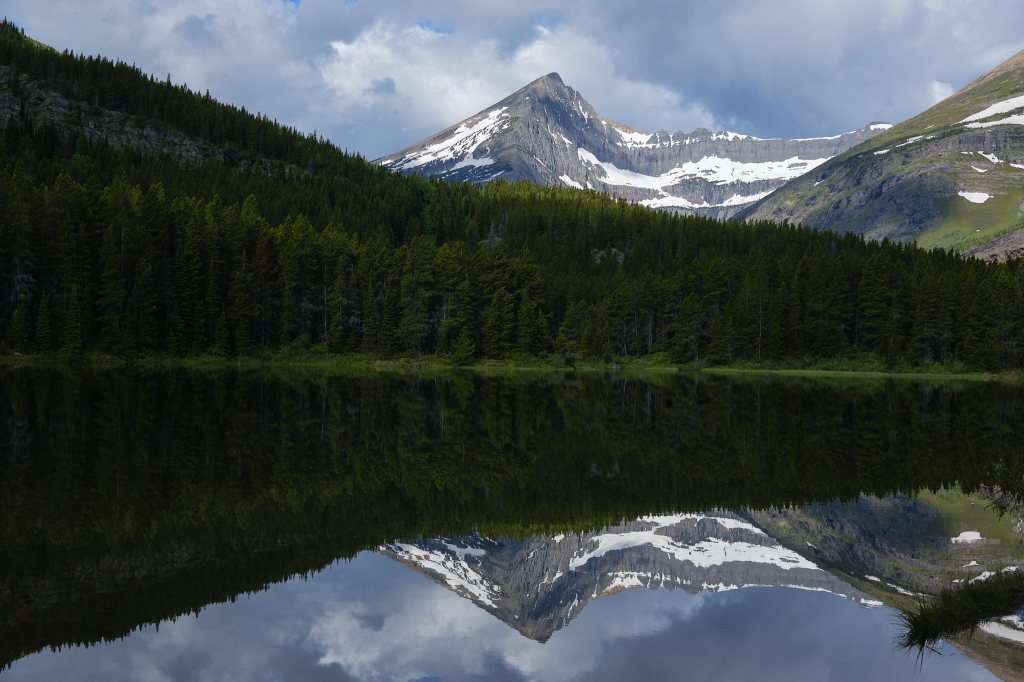
About a mile down the trail gave us our first view of Red Rocks Falls from across a lake. Ranger Diane pointed out the peak called Heavy Shield and Swiftcurrent Pass beside it. There was a big forest fire in this area in 1936 which burned most of the forest we were looking it. It approached The Many Glacier Hotel where guests were evacuated and staff and firefighters hosed the building down through the night and managed to, for the most part, save it.
At the top of Swiftcurrent Peak we were encouraged to find what looked like a small rectangular box. This is a fire lookout tower, where park staff hike up and take ten day shifts to watch for wildfires. Satellites and tech have eliminated the need for many of these towers, but this is one of four that remain. It is an essential job and takes a particular kind of person to do it. Ranger Diane told us of a mother who loved the work and would bring her growing babies up with her. Imagine having a toddler up there?! Impressive? Or crazy? I say the former. Can’t be many germs up there, and what a view!
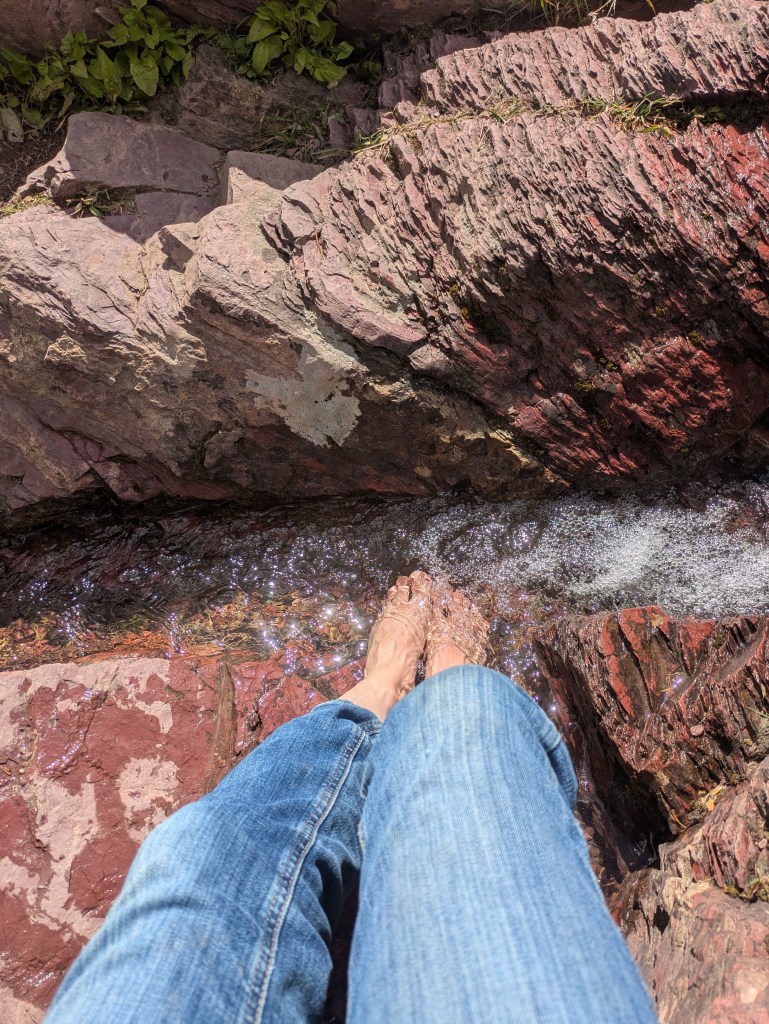
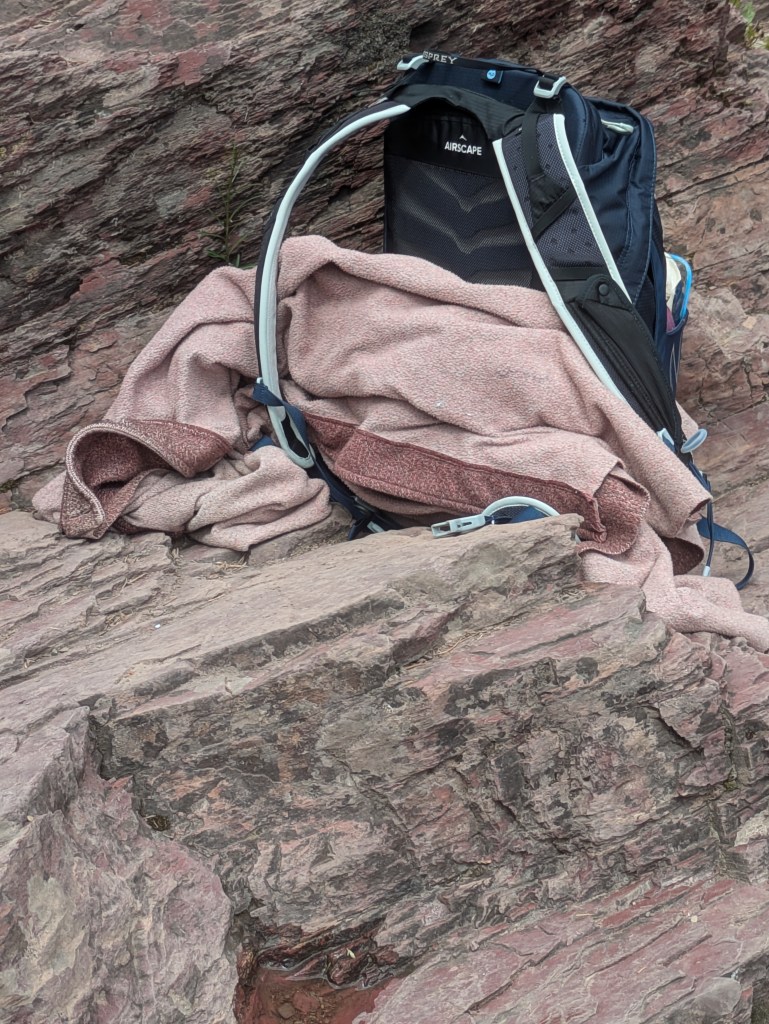
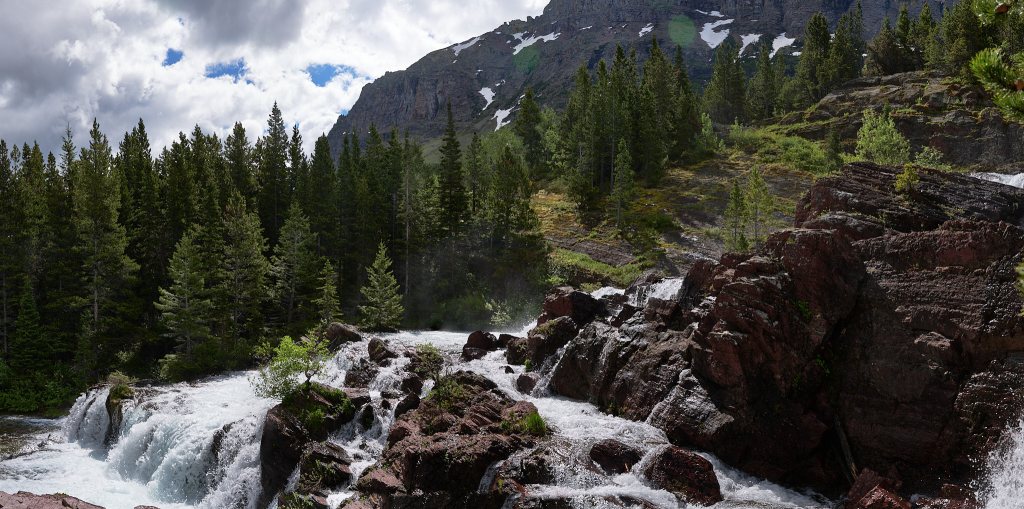
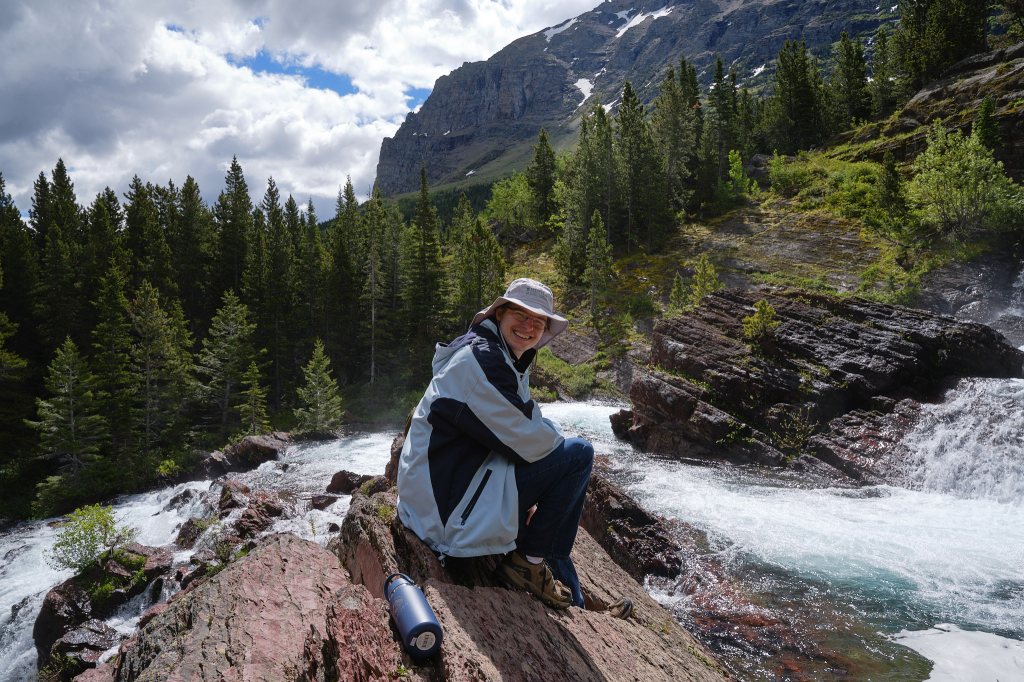
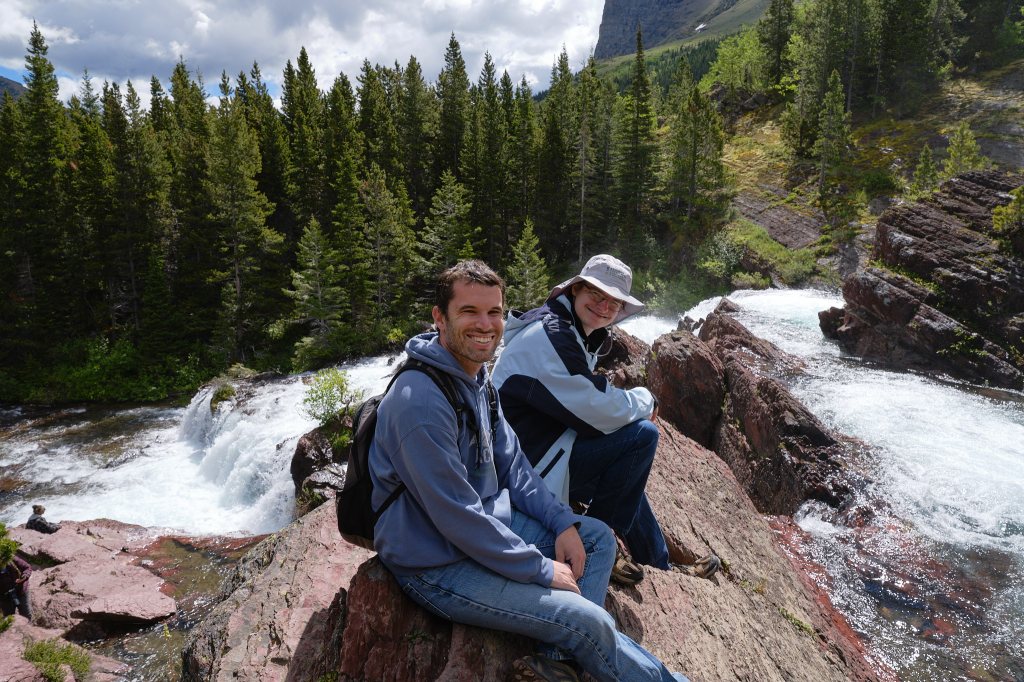
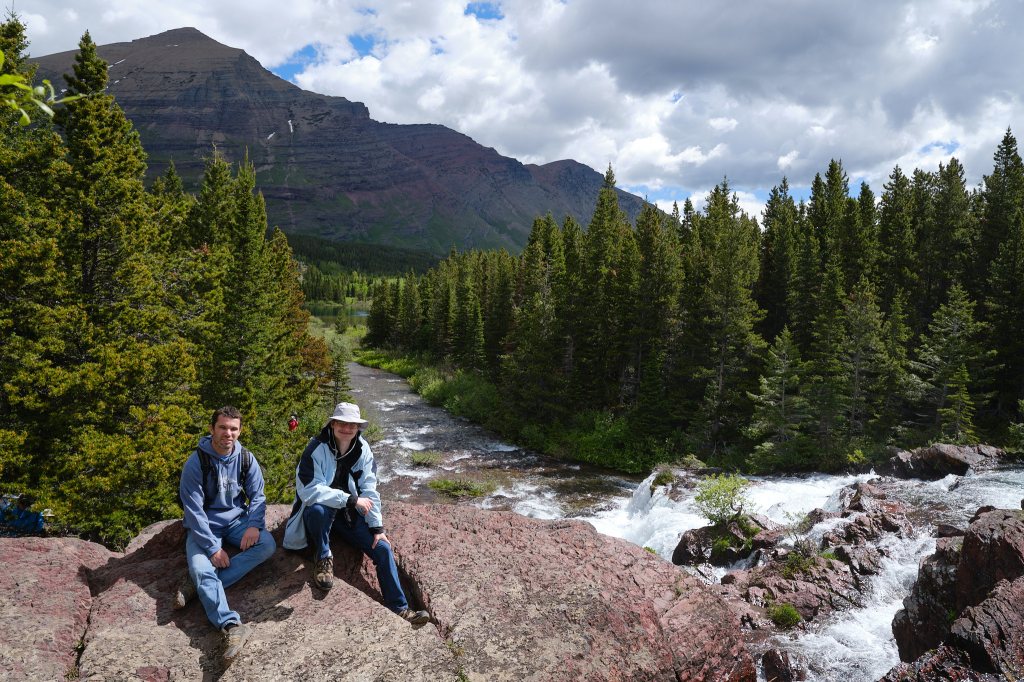
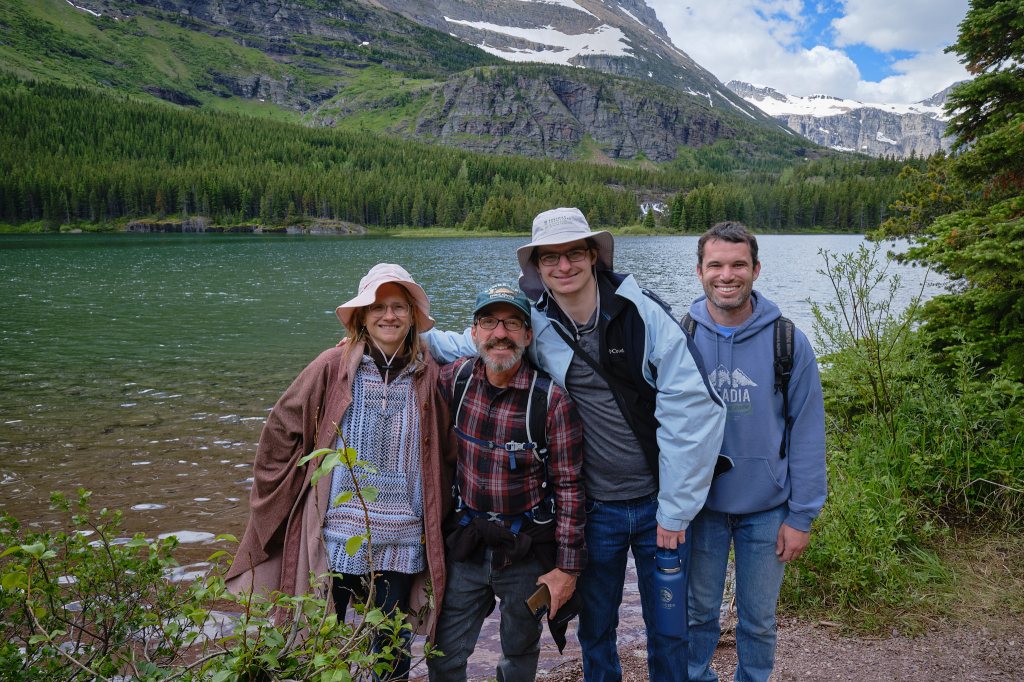
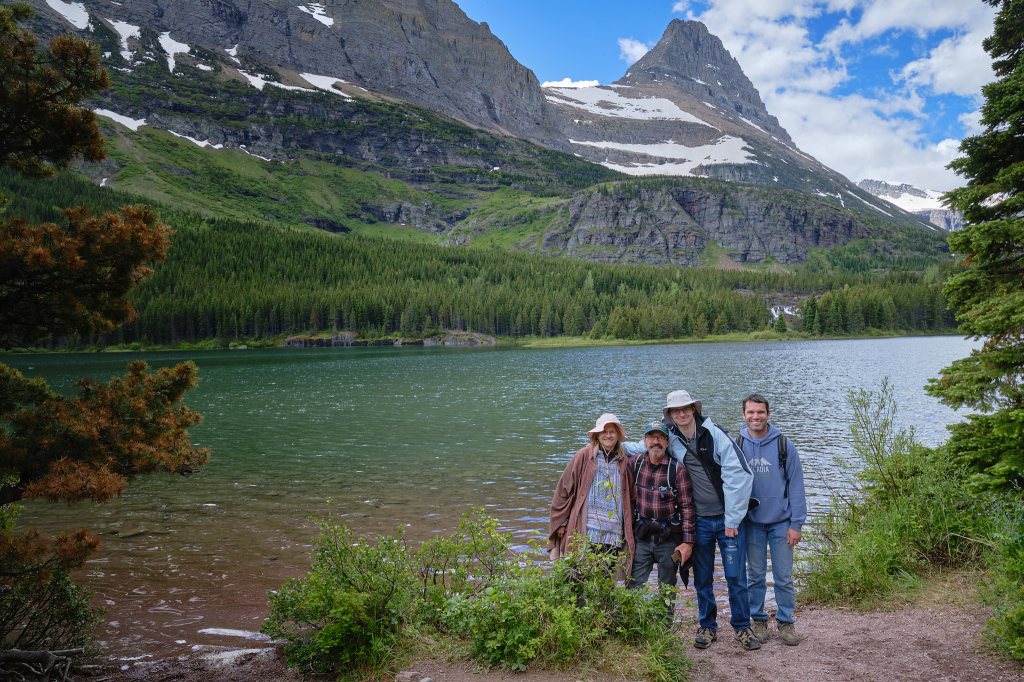
Arriving at Red Rock Falls we were amazed. It is a wide, rushing waterfall with rocks of deep red. I took off my cloak, (which turns out to be the same color as the rock) settled onto a comfy boulder, took off my shoes, and wiggled my toes in the icy cold water. Ben and Mike climbed to the top of the falls. Cary wandered around the area. Ranger Diane stayed for about twenty minutes, then left us all to get back at our own pace.
Our afternoon was a relaxing one. We four picnicked together on the Swiftcurrent porch for lunch, then went our separate ways. I must say there is nothing like an afternoon nap after a good hike!
We decided to try eating dinner at The Many Glaciers Hotel. Ben and Cary were up for a walk, so took the wooded trail. Mike and I drove over and met them. It gave me a chance to look at the large water fall there, which I hadn’t yet seen. Impressive! What is it about waterfalls of any size that amazes us humans?
Our plans for the next day were not yet set so we sat by the lobby fire place and discussed our options. Mike wanted to take a hike to Grinnell Lake, which would be at least eight miles round trip. Cary thought a boat trip across two lakes would be nice. Ben wanted to go on a horseback ride. Still undecided we got in line for dinner. We were told the wait would be at least forty five minutes. Too long for Ben and Cary. But Mike and I thought a fine dinner in a fancy dining room would be nice. So I waited in the lobby for our name to be called while Mike took the “boys” back to eat at Nell’s. They made the better choice!
Mike and I were given a table for two right at the window with the stunning view we already loved so much. The menu was promising. A pianist entertained the room. Our glasses of ice water were constantly refilled by the friendly wait staff.
But when the food arrived it was terrible! Barely edible. Mike’s baby-bowl sized portion of pasta primavera was topped with a dried out chicken cutlet that was overly spiced. My hummus was laced with that same strong spice and surrounded by limp cucumbers and stale pita bread. At least the basket of rolls and butter was decent. And the pianist played an endless stream of Elton John tunes. (Not that I have anything against Elton John, but how about changing it up a bit?) Guess the price we paid dinner was really for the view.
As the sky considered getting dark (the sun sets so late up here in summer), we found Ben and Cary back at the cabins. We formulated a plan for the next day which would take into account everyone’s comfort level.
Then it began to rain. Which, in my opinion, is an excellent lullaby. Do you agree?


Leave a Reply